

Indigo
Indigo is backordered and will ship as soon as it is back in stock.
Delivery and Shipping
Delivery and Shipping
For more details, please refer to our Shipping and Order Information.
Game details
- Reiner Knizia Designer
- 2–4 PlayersBest: 4
- 30 min Play time
- 8 and up Age
- ★ 6.9/ 10 BGG rating
- #1832 BGG rank
Awards & honors
- 2012 Kinderspielexperten "8-to-13-year-olds" Nominee
- 2012 Kinderspielexperten "8-to-13-year-olds" Second Place
View all honors (8)
- 2012 Kinderspielexperten "8-to-13-year-olds" Nominee
- 2012 Kinderspielexperten "8-to-13-year-olds" Second Place
- 2012 Spiel der Spiele Hit für Familien Recommended
- 2012 Spiel des Jahres Recommended
- 2012/Fall Parents' Choice Gold Award Winner
- 2013 As d'Or - Jeu de l'Année Nominee
- 2013 Golden Geek Best Abstract Board Game Nominee
- 2013 Le Lys Grand Public Finalist
 (opens in a new tab)
Note: This game is in English
Indigo is a tile-laying game along the lines of Metro, Tsuro and Linie 1 in which players build paths bit by bit, with no player owning the individual paths and everyone trying to exploit the paths already present. Unlike those earlier games, however, your goal is to move gemstones from their starting locations on the board to your designated goals, with the player who scores the most points winning the game.
To set up the game board, place the central hex tile, then add five green and one indigo gems to it. Place six "u-turn" tiles at their designated locations on the outer edge of the game board, then place a yellow gem on each such tile. Each player places goal markers on goals between these u-turn tiles on the edge of the game board: in a two-player game, the players alternate goals; in a three-player game, each player has one goal to herself, while sharing two others; and in a four-player game, each player shares a goal with every other player.
On a turn, a player places a tile on any space on the game board, with the only restriction being that a player cannot create a route directly from one goal to another. Each tile has three route segments on it, connecting one pair of edges. If a player places a tile next to a gemstone, that gemstone "moves" as far as possible along the route so that all players can see where to place tiles to next move that gemstone. (Thus players avoid the mental gymnastics required inMetro and Linie 1 in which nothing moves until a route is complete.) When connecting to the central tile, the green gems move off first, with the indigo gem moving only with the sixth connection.
If a player places a tile so that one gem would run into another, both gems are removed from the game!
When a gem is moved to a goal owned by only one player, that player keeps the gem. If two players own the goal, then both players collect a gem of that color, taking the extra gem needed from the reserve. Once all the gems have been claimed, the game ends, with players earning 3 points for an indigo gem, 2 for green and 1 for yellow. The player with the most points wins.

Indigo

Indigo is backordered and will ship as soon as it is back in stock.
Payment & Security
Payment methods
Your payment information is processed securely. We do not store credit card details nor have access to your credit card information.
More by Reiner Knizia
Same designer — often a different theme or play style

Alley Cat Games
Amun-Re: 20th Anniversary Edition (Standard Edition)
2–5 players1–2 h MediumBGG 7.5
Regular price$62.95 CADOnly a few left
GMT Games
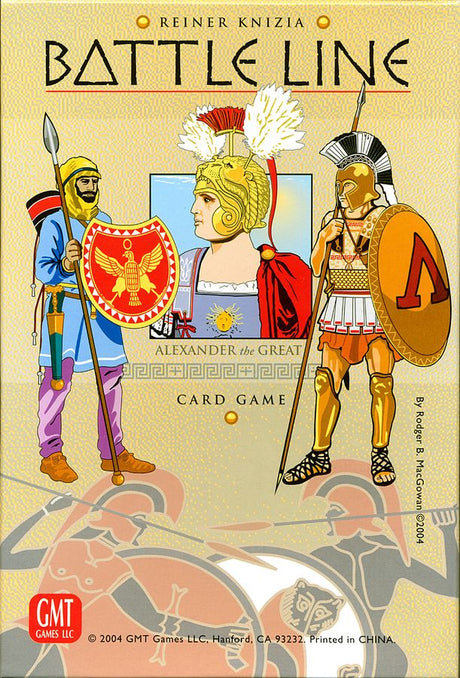
Battle Line Original Edition (12th Printing)
2 players30–60 min LightBGG 7.4
Regular price$24.95 CADOnly a few left Pre-order
GMT Games
Battle Line: Medieval-Themed Edition (2nd Printing) *PRE-ORDER*
2 players30–60 min LightBGG 7.6
Regular price$26.95 CADExpected Q4 2026 Pre-order
 37% off
Pegasus Spiele
Brains Family: Burgen & Drachen (Box Damage)
2–4 players30–60 min LightSale price$21.95 CAD Regular price $34.95 CAD 37% offOnly a few left 20% off
Capstone Games
2–4 players30–60 min LightSale price$39.95 CAD Regular price $49.95 CAD 20% offOnly a few left Sold out
 Sold out


